C++:走向现代化#
本文主要内容整理自本贾尼·斯特劳斯特卢普(Bjarne Stroustrup)发表的著作和论文,相关内容参见文末参考资料。
0. 当我们说 C++ 的时候,我们在说什么#
对用户而言,“C++”不只是由标准定义的程序设计言,而是由很多部分组成的集合,不限于:
- 由标准定义的语言规范
- 标准库
- 其它的库
- 大量的(遗留)代码库
- (包括其他语言开发的)工具
- 教学和培训资源
- 社区支持
1. C++ 简史#
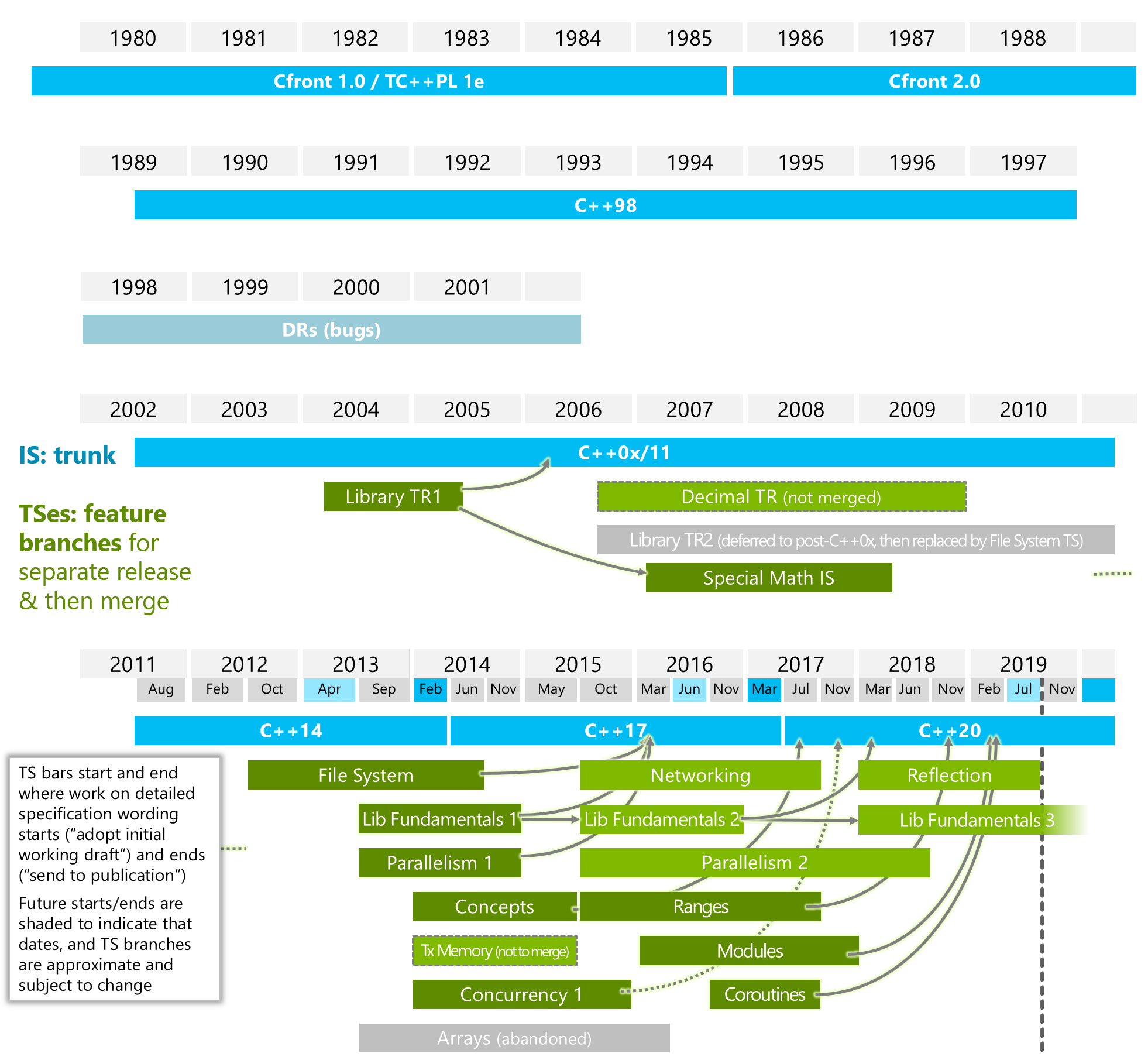
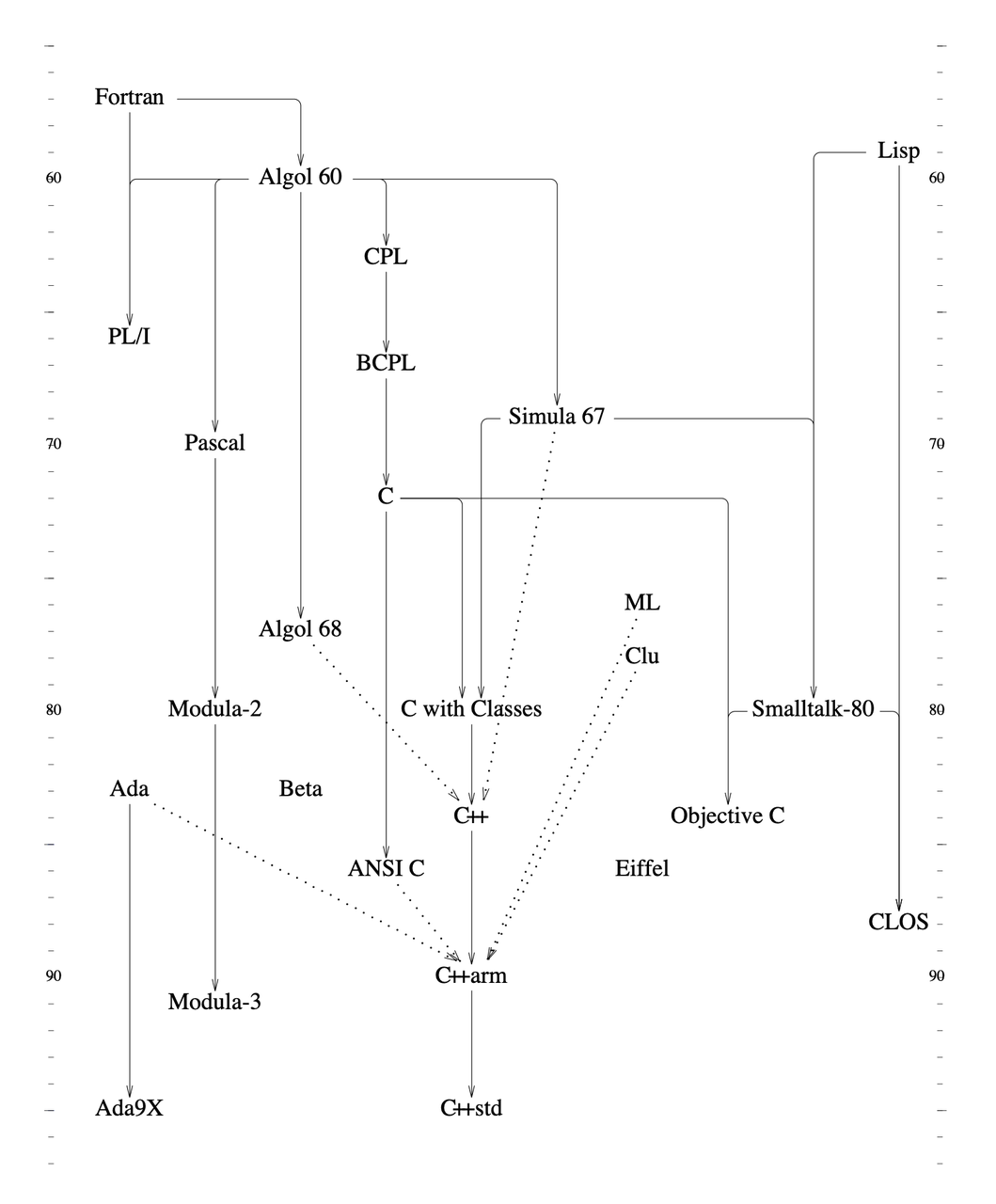
C with Classes -> C84 -> Release 1.0(Cfront) -> Release 1.2(Cfront) -> Release 2.0(Cfront) -> ARM -> C++98(std) -> C++03(std) -> C++11(std) -> C++14(std) -> C++17(std) -> C++20(std)
- 1979: Start of work on “C with Classes” that became C++; first non-research user;
- Language:
classes, constructors/destructors,public/private, simple inheritance, function argument type checking - Library:
tasks (coroutines and simulation support),vectorparameterized with macros
- Language:
- 1985: First commercial release of C++; TC++PL1
- Language:
virtualfunctions, operator overloading, references, const - Library:
complexarithmetic, stream I/O
- Language:
- 1989-91: ANSI and ISO standardization start; TC++PL2
- Language: abstract classes, multiple inheritance, exceptions, templates
- Library: iostreams (but no
tasks)
- 1998: C++98, the first ISO C++ standard, TC++PL3
- Language:
namespaces, named casts,bool,dynamic_cast - Library: the STL (containers and algorithms),
string,bitset
- Language:
- 2011: C++11, TC++PL4
- Language: memory model,
auto, range-for,constexpr, lambdas, user-defined literals, ... - Library:
threads and locks,future,unique_ptr,shared_ptr,array, time and clocks, random numbers, unordered containers (hash tables), ...
- Language: memory model,
- 2014: C++14
- Language: generic lambdas, local variables in
constexprfunctions, digit separators, ... - Library: user-defined literals, ...
- Language: generic lambdas, local variables in
- 2017: C++17
- Language: structured bindings, variable templates, template argument deduction from constructors, ...
- Library: file system,
scoped_lock,shared_mutex(reader-writer locks),any,variant,optional,string_view, parallel algorithms, ...
- 2020: C++20
- Language:
concepts,modules, coroutines, three-way comparisons, improved support for compile-time computation, ... - Library: concepts, ranges, dates and time zones,
span, formats, improved concurrency and parallelism support, ...
- Language:
2. 传统 C++ 的设计规则#
2.1. 设计目标(Aims)#
C++ 使认真的人更享受编程的乐趣
C++ makes programming more enjoyable for serious programmers
C++ 是一个通用程序设计语言,它更倾向于系统编程,并且
C++ is a general-purpose programming language with a bias towards systems programming that
- 是更好的 C(is a better C)
- 支持数据抽象(supports data abstraction)
- 支持面向对象编程(supports object-oriented programming)
- 支持泛型编程(supports generic programming)
2.2. 一般性规则(General Rules)#
- C++ 的发展必须由实际问题推动
- 不应被牵涉到无益的对完美的追求中
- C++ 必须是现在就有用的
- 每个特征必须存在一种合理的明显实现方式
- 总是提供一个变通的方法
- C++ 是一种语言,而不是一个完整的系统
一个程序设计环境包含了许多部分,一种方式是将多个部分组合成一个“集成化的”系统,另一种方式是维持系统中各部分之间的经典划分,例如编译器、连接器、语言的运行支持库、I/O库、编辑器、文件系统、数据库,等等。C++遵循的是后一条路。
- 为每种应该支持的风格提供全面支持
- 不试图去强迫人做什么
程序员都是聪明人:),总能找到方法绕过觉得无法接受的规则和限制。
2.3. 支持设计的规则(Design Support Rules)#
- 支持健全的设计概念
- 为程序的组织提供各种机制
- 直接说出你的意思
允许用语言本身表达所有重要的东西,而不是在注释或者通过宏这类黑客的手段。
- 所有的特征都必须是能负担的
- 允许一个有用的特征比防止各种错误使用更重要
- 支持从分别开发的部分出发进行软件组合
2.4. 语言的技术性规则(Language-Technical Rules)#
- 不隐式地违反静态类型系统
- 为用户定义类型提供与内部类型同样好的支持
- 局部化是好事情
- 避免顺序依赖性
- 如果有疑问,就选择该特征的最容易说清楚的形式
- 语法是重要的(常以某些我们不希望的方式起作用)
- 清除使用预处理程序的必要性
支持Low-Level编程的规则(Low-Level Programming Support Rules)
- 使用传统的(dumb)连接器
好的连接兼容性:容易移植,容易与用其它语言编写的软件互操作。
- 没有无故的与C的不兼容性
- 不为比C++低级的语言保留生存空间(除了汇编)
同时提供低级特征和抽象机制
- 不为不使用的特性付出代价(zero-overhead rule)
- 为存疑的东西提供人工介入的手段
比如模版的特化
3. C++ in 2006#
3.1. 环境的改变#
- 单处理器(单核)性能增长放缓,能效成为关键指标
- 硬件供应商绑定开发语言,平台分立(Smart phone)
- 新老项目都在向更时髦的平台转移
- 学校教学和考试更青睐Java,C++课程教学质量下降
3.2. C++ vs Java & C##
C ++ 基于“程序设计语言与底层操作系统分离”的传统模型,由众多独立工具供应商提供支持。而托管语言往往是专有的,由强大的组织支持。该组织开发庞大的基础架构和库,以供开发者使用。
C++ is based on the traditional model of a programming language separate from the underlying operating system and supported by a multitude of independent tool suppliers. The managed languages tended to be proprietary; only a large and rich organization could develop the massive infrastructure and libraries required.
3.3. Java & C# 的观点#
- 低级(low level)的需求应该由少量的 C 或汇编完成;
- 高级(high level)的需求应该由具有广泛运行时支持的、安全的、带垃圾回收的语言完成,这样更好、更低价、更高效;
- Java 和 C# 这样的托管语言,提供垃圾回收和运行时检查,使专家程序员更高产,也使入门更简单;
- 程序设计语言要和平台深度集成,集成工具集对于构建大型系统和提高生产效率是必不可少的。
3.4. C++ 的劣势#
- 工具链上手门槛高
- 接口灵活性和 ABI 稳定性不可兼得
- C++ 标准委员会具有大组织的通病
4. C++11: It Feels Like a New Language#
支持并发,简化编码(开发),增强泛型编程,静态安全类型扩充,对创建工具库的支持,标准库扩充
4.1. 语言特性#
- 内存模型:基于现代硬件环境,针对并发的高效 low-level 模型
memory model - an efficient low level-model of modern hardware as a foundation for concurrency
auto和decltype:简化类型声明- range-
for:简化范围迭代 - 移动(move)语义和右值引用:减少数据拷贝次数
- 统一的初始化:一致的对象和内置类型的语法(语义)
nullptr:空指针语义(类型和值两方面)constexpr函数:编译期求值函数- 用户定义字面量:用户定义类型的字面量
- 原始字符串字面量:不转义字符
- 属性(attributes):本质上是关联任意信息和名字
- lambdas:匿名函数对象
- 可变参数模板(variadic
templates):可以处理不定数量任意类型参数的模板 - 模板别名:重命名,并绑定模板参数
noexcept:担保函数不会抛出异常override和final:用于类继承的语法扩充static_assert:编译期断言long long:更宽的整型- 成员默认初始值:不用通过构造函数初始化列表设置成员默认值
enum classes:带作用域的强类型枚举
4.2. 标准库#
unique_ptr和shared_ptr:实践 RAII 的资源管理指针- 内存模型和原子量(atomic)
thread,mutex,condition_variable:类型安全且可移植的系统级并发支持function,bind:通用函数封装器future,promise,packaged_task:轻量的高级并发工具tuple:匿名的基础复合类型- 类型萃取(type traits):用于元编程的类型属性识别
- 正则表达式
- 随机数:支持多种生成器和数据分布
- 时间(Time):
time_point和duration unordered_map等:哈希表forward_list:轻量级链表array:长度可知的固定长度数组- 花括号(emplace)运算:构造容器时避免对象拷贝
exception_ptr:跨线程传递异常
5. C++14: Completing C++11#
ABI稳定,无痛升级
5.1. 语言特性#
- 二进制字面量:
0b1001000011110011 - 数字分隔符:增强可读性,
0b1001’0000’1111’0011 - 变量模板:参数化常量和变量
- 函数返回值类型推导
对 c++11 中 lambda 返回值类型推导的推广
- 泛型lambda
constexpr函数支持局部变量- 移动(move)捕获:
[p = move(ptr)] { /* ... */ }; - 带类型的tuple访问:
x = get<int>(t); - 标准库支持用户定义字面量:
basic_string、duration与complex
6. C++17: Lost at Sea#
新特性很多,但没有重大改进
6.1. 语言特性#
auto [x,y,z] = f(); // call syntax, introducing aliases
inline变量:简化仅头文件的库中具有静态存储期的变量的使用- 折叠表达式:简化变参模板的使用
- 判断(
if、switch和while)语句中的初始化器:类似for语句 - 强制的复制消除:消除一些多余的拷贝运算
- 更严格的求值顺序:防止一些细微的求值顺序错误
auto占位的非类型模板形参:值模板参数类型推导- 捕获通用错误的新属性:
[[maybe_unused]],[[nodiscard]], and[[fallthrough]] - 十六进制浮点字面量
- 编译期的
constexpr if语句:简化编译期求值代码
6.2. 标准库#
optional,variant,any:表示可选值的标准库类型shared_mutex,shared_lock(读写锁),scoped_lock(加多个锁,且不会引发死锁)- 并行STL:标准库算法的多线程和/或向量化版本
- 文件系统:操纵文件系统的路径和目录的可移植方式
string_view:引用(非所属的)不可变字符序列- 数学特殊函数:Laguerre多项式,Legendre多项式,beta函数,黎曼zeta函数
7. C++20: A Struggle for Direction#
继C++11后的又一重大突破
7.1. 主要特性#
- Concepts:specification of requirements for generic code
- Modules:support for modularity for code hygiene and improved compile times
- Coroutines:stackless coroutines
- Compile-time computation support
<=>:a three-way comparison operator- Ranges:a library flexible range abstractions
- Date:a library providing date types, calendar, and time zones
- Span:a library providing efficient and safe access to arrays
- Format:a library providing type-safe printf-like output
- Concurrency增强:such as scoped threads and stop tokens
7.2. 次要特性#
- C99-style designated initializers
- Refinements to lambda capture
- Template parameter lists for generic lambdas
- Initialization of an additional variable within a range-for
- Lambdas in unevaluated contexts
- Pack expansions in lambda capture
- Removing the need for
typenamein some cases - More attributes:
[[likely]]and[[unlikely]] source_locationto give the source code location of a piece of code without the use of macros- Feature test macros
- Conditional
explicit - Signed integers are guaranteed to be two’s complement
- Mathematical constants, such as
piandsqrt2 - Operations on bits, such as rotations and counting ones
8. C++23#
8.1. 开发中的特性#
- Networking and executors
- Contracts:assertions, preconditions, and postconditions
- Static reflection:facilities for generating code based on the surrounding program
- Pattern Matching:selecting code to be executed based on types and object values